Hidden Risks of Buying an Apartment in Guwahati: Why Independent Due Diligence Matters
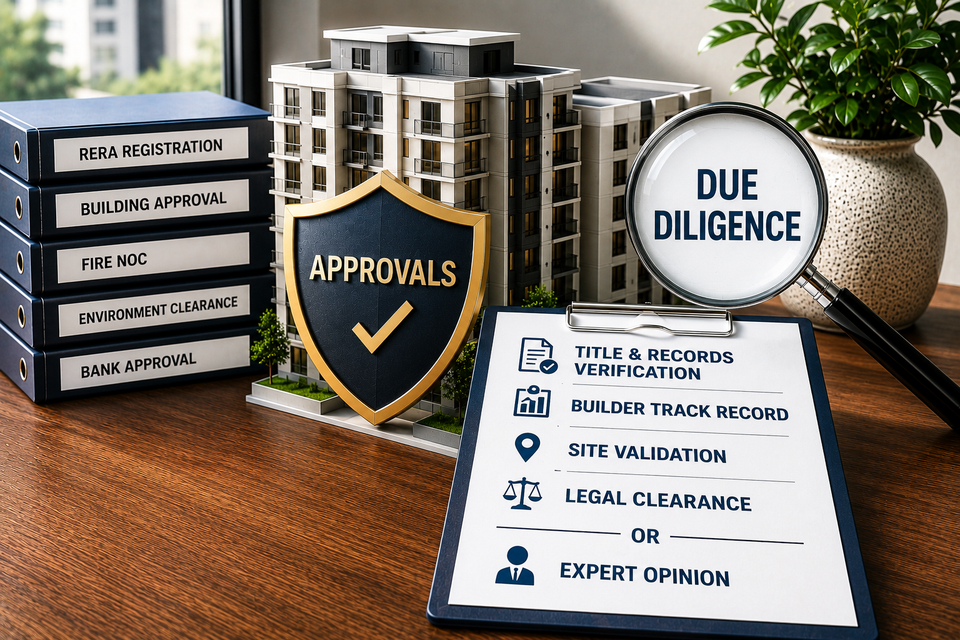
Buying a flat is often perceived as safer and more straightforward than buying land or an independent house. Many homebuyers assume that once a project has received the necessary approvals from the Guwahati Metropolitan Development Authority (GMDA) and the Guwahati Municipal Corporation (GMC), the property is fully secure.
By comparison, purchasing land or an independent house tends to create greater hesitation, particularly among first-time buyers. Questions about ownership, title, documentation, and long-term security naturally arise. In such situations, experienced real estate advisors play a vital role in verifying information, identifying potential risks, and helping buyers make informed decisions.
A Common Misconception
Many people believe that official approvals automatically guarantee the legitimacy of an apartment project. While such approvals are undoubtedly important, they do not eliminate every risk.
In some instances, approvals are granted based on the plans and documents submitted by the developer, whereas the actual construction may differ from what was originally approved. For this reason, regulatory approvals should be viewed as one part of the due diligence process, not its conclusion.
A Case from Guwahati
In one case involving an apartment project in the Rukminigaon area of Guwahati, the developer obtained planning approval from GMDA and a building permit from GMC.
Several purchasers had already bought flats through bank financing, believing that the regulatory approvals and bank loan sanctions were sufficient to assure them of the project's legitimacy.
Following a written objection filed by the original land owner, GMDA and GMC conducted a detailed enquiry and further verification.
The GMDA subsequently revoked the planning permission, stating that it had been obtained for one Dag number while the construction had been carried out on a different Dag number. The GMC later revoked and cancelled the corresponding building permit.
The Real Lesson
Many homebuyers rely entirely on a builder's assurances, bank loan approvals, or regulatory approvals without undertaking independent due diligence.
However, property transactions often involve legal, technical, and location-specific complexities that may not be immediately apparent. Regulatory approvals reduce certain risks, but they cannot replace careful verification of the property's legal status, location, documentation, and compliance.
Final Thoughts
Whether you are purchasing a flat, land, or an independent house, careful due diligence remains essential.
Experienced local advisors can often identify inconsistencies, title-related issues, location-specific risks, and practical concerns that may not be apparent to buyers.
In property transactions, informed decisions do more than protect your investment. They help prevent years of avoidable legal, financial, and emotional stress.